

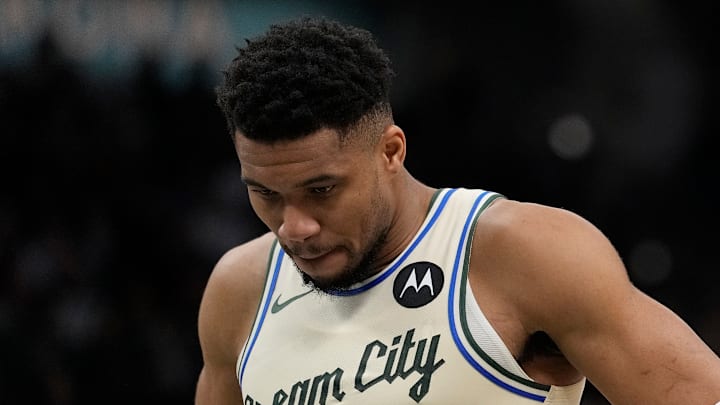
Sitting in 11th place and outside the Play-In picture in the Eastern Conference, the Milwaukee Bucks find themselves lagging far behind in the NBA's latest arms race towards supremacy in crashing the offensive glass.
In a desperate search for an on-court identity and with few avenues to improve the roster ahead of this season's trade deadline, Milwaukee's front office can buck the league-wide trend in future moves by emulating the framework employed by the defending champion, the Oklahoma City Thunder, who have similar deficiencies rebounding the ball.
The Bucks are not in an enviable position at the moment. Between Kevin Porter Jr. and Giannis Antetokounmpo's latest injury updates, Giannis's recent comments about poor chemistry, and limited assets at GM Jon Horst's disposal to put the team in a position to make a legitimate playoff push, other teams around the league are sensing blood in the water.
Despite this, all messaging from the Bucks' side seems to indicate that they intend to seek upgrades to the current roster to take advantage of a weak Eastern Conference landscape, rather than lean into the tank in a year where they actually own and effectively control their own first round pick (Milwaukee keeps the least favorable between its own 2026 first rounder and that of the bottom-dwelling Pelicans).
Mounting pressure from Antetokounmpo continues to drive the front office to remain competitive in what might have otherwise been a strategic gap year, but Jon Horst has had an uncanny knack for extending the window of this Bucks post-championship era through creative accounting and savvy margins moves in addition to the occasional home run swing. If the Bucks truly intend to attempt to turn this season around, though, it will need to start with establishing a clear identity.
A brief history of the NBA's great rebounding paradox
The NBA has long been a copycat league, but it is also cyclical. In the decades leading up to the introduction of the 3-point line in 1979, NBA teams had long prioritized offensive rebounding with the game heavily reliant on close-range shots and post scoring.
Even in the early days of the 3-pointer, the low volume of long-range attempts led to fewer long rebounds that would otherwise put transition defenses at a numbers disadvantage on fast breaks. This schematic tradeoff between prioritizing second chance buckets or optimizing transition defense, otherwise defined as the NBA's great rebounding paradox, has haunted the broader NBA narrative from the beginning.
After the league banned physical defensive hand-checking following the Pistons' unlikely 2004 title over the Lakers, NBA offenses began to free up on the perimeter and increase their 3-point volume. Born out of this rule change and in response to the recent legalization of zone defense at the pro level, which allowed teams to pack the paint, Mike D'Antoni's "Seven Seconds or Less" system, led by Steve Nash in Phoenix, revolutionized offense across the league with increased pace, space, and movement.
This innovative style laid the groundwork for the modern 3-point revolution, but D'Antoni's Suns ultimately failed to reach the championship summit, doomed to consistently run up against Tim Duncan's defensive juggernaut Spurs year after year. San Antonio's philosophy, engineered by Gregg Popovich to counteract Phoenix's high-octane offensive approach, opted to sacrifice offensive rebounding opportunities in favor of sending more players back to defend in transition.
This method slowed the game down to the Spurs' desired pace and forced the Suns' offense into more half-court sets, where Duncan and the Spurs' gritty defense could swallow them up.
D'Antoni's legacy of pace and space, however, continued to ripple through the league until Steph Curry and the Warriors' death lineup set the NBA world ablaze with their unique brand of weaponized three balls and positionless basketball, marking not only the beginning of the modern era but also a major shift away from the emphasis on crashing the offensive glass.
The answer to the NBA's great rebounding paradox became the conventional approach as more teams tried to replicate the Warriors' success, including D'Antoni's own five-out Rockets offense built around James Harden.
The recent shift back to offensive rebounding
In recent years since the 3-point revolution, though, teams have begun to employ more size to counteract "small ball" positionless hoops made popular by tweener, de facto centers like 6-foot-6 Draymond Green and six-foot-five PJ Tucker. The emergence of more highly-skilled, generational bigs like Jokic, Giannis, and, most recently, Victor Wembanyama has caused the rebounding pendulum to begin swinging back in the other direction.
Whereas teams previously needed to sacrifice size to achieve optimal spacing conditions, the current generation of bigs has afforded new luxuries for NBA coaches. As such, offensive rebounding rates have exploded in the past five years.
In 2020-21, the season capped by the Bucks' first NBA championship in fifty years, just one team had an offensive rebounding rate above 30 percent. In 2025-26, that same benchmark expanded to 18 teams. Most notably, the Houston Rockets crash the offensive glass at a staggering 40.5 percent rate. The Pistons, Celtics, and Knicks have also successfully employed this strategy in the East.
Unfortunately for the Bucks, rebounding, particularly offensive rebounding, has been one of the team's fatal flaws all season long, ranking 29th out of 30 teams in offensive rebounding percentage (OREB%) with their undersized personnel.
The only team with a lower rate than the Bucks when it comes to crashing the offensive glass? That's right, you guessed it: the Oklahoma City Thunder, who nearly lap the rest of the field in point differential at +13.3 and a record of 37-9. The Thunder and Bucks rank 24th and 29th, respectively, in overall rebounding rate, separated by just 0.9 percent.
That's not the only similarity, though. The Thunder and Bucks are tied for second with an effective field goal rate of 56.7 percent, evidence of both teams' efficient shot selection. So what accounts for the gap between the Thunder's dominance at the top of the Western Conference and the Bucks' -3.6 point differential amongst the dregs of the East?
Following the Thunder's example
First and foremost, the Thunder's calling card is their brand of suffocating and aggressive defense, leading the NBA in defensive rating by a wide margin, while the Bucks rank in the bottom 10. Another major difference is their proficiency in winning the turnover battle. The Thunder have the lowest rate of turning the ball over in the league, whereas the Bucks rank 18th.
The Thunder also force opponents into the most turnovers with their hack-first-ask-questions-later mentality. The Bucks rank 21st in opponent turnover rate, comparatively.
The Bucks do have the bones of a capable defense on paper and in certain statistical categories. For one, they have the tandem of Myles Turner and Giannis Antetokounmpo to provide ample rim protection, if healthy. When it comes to opponent points in the paint, the Bucks allow the fifth-least per game. Behind the disruptive activity of Ryan Rollins and Kevin Porter Jr., they also rank 10th in deflections with 18.2 per game. Inconsistency in defending the perimeter and late rotations, however, have led to the team being bottom-5 in contesting shots both inside and outside the arc.
Long stretches playing without superstar Giannis Antetokounmpo available have led to prolonged bouts of disorganized offense, as well as overall sloppy play from the Bucks' overtasked secondary ball handlers. With Porter Jr. and now Giannis likely to miss extended time, Jon Horst will first need to find a scoring stopgap and secondary offensive release valve to spell Antetokounmpo upon his return. Giannis has clearly felt the effects of carrying an increased load on both sides of the court this season, and it has led to more nagging injuries.
Forwards Bobby Portis Jr. and Kyle Kuzma are two players commonly floated in trade packages for potential playmaking upgrades. While both players offer the matching salaries required to bring back a player of sufficient merit, moving on from either would give the Bucks even less size to compete on the glass than before, which will only be exacerbated with Giannis sidelined in the coming weeks.
With that in mind, perhaps it makes sense for the Bucks to pivot in the opposite direction from where the league is trending. Given the lack of realistic options to meaningfully improve their rebounding woes due to that skillset's high demand in the current market, maybe it makes sense for Milwaukee to follow the Thunder's model and prioritize a tone-setting defense over crashing the glass.
Establishing a defense-first identity
Rather than potentially overpaying for a rebounding upgrade, the Bucks can look to find defensive help at the wing and forward spots to shore up their interior and perimeter defense inconsistencies. If they can amp up the defensive pressure to turn more deflections into turnovers, it would take scoring pressure off Giannis in the half-court as well when he returns, allowing him to expend more energy on the defensive end hunting blocks and steals from the weak side.
Recognizing that rebounding is not a strength of the roster, if they can manage to win the turnover battle and bring down enough defensive boards to adequately end possessions, they might be able to recreate some semblance of the Thunder's formula. If they can, it could be enough to get back into the Eastern Conference Play-In picture and keep their disgruntled superstar bought in long enough until more significant moves can be made in the offseason.
Establishing a clear defense-first identity could potentially help Myles Turner find his rhythm as well. His impact on defense has suffered in part due to the lack of overall cohesion and effective communication from the team on that end of the court. Even if the Bucks fail to salvage the defense for this season, getting back to that level of intensity reminiscent of their championship culture can't be a bad thing in any case.
Some players that fit the mold amongst the Bucks' realistic trade targets include Dillon Brooks, Keon Ellis, Caleb Martin, and Grant Williams. Of those players, Brooks is an intriguing option who could provide a scoring punch as well.
While filling the scoring and playmaking void left in Kevin Porter Jr. and Giannis's imminent absences will be paramount as well, the Bucks' future moves between now and the deadline need to commit to a clear defensive identity. Attempting to cover its glaring rebounding flaws will only doom the team to continued mediocrity.
 Add us as a preferred source on Google