

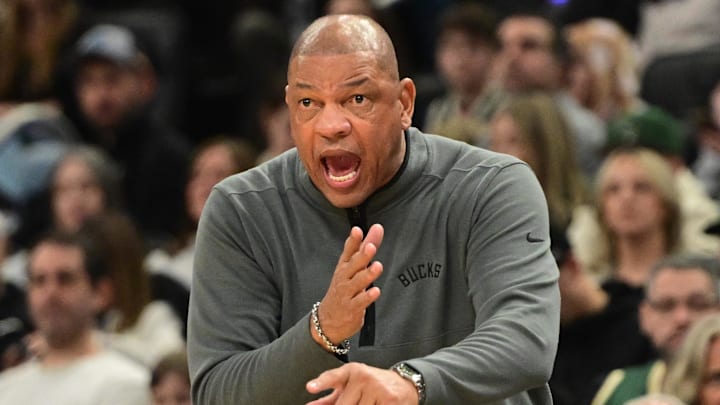
It all went downhill for the Milwaukee Bucks after the first quarter against Toronto. A discombobulated, stagnant offense was a major reason. A physical Raptors defense stifled the Bucks' ball movement, producing too many contested shots and fruitless isolation attempts.
Speaking postgame, Doc Rivers issued a harsh reality check to his playmakers in particular.
"You know, it's a good lesson for us, especially for our young guards. They got into 'em, and instead of just playing right, and playing the same way, it made them go one-on-one back at them and then the game turned into a one-on-one game," he said of how Raptors defenders disrupted Milwaukee ballhandlers. Then he delivered the real kicker. "We're just not good enough to play that way."
Wisdom from Doc Rivers doesn't always prove to be wise, but in this case, the Milwaukee Bucks guards should keep his words in mind.
Milwaukee's young playmakers just have to stay within themelves
On a day when the offense couldn't get anything going, Kevin Porter Jr. turned in one of the few positive performances: 8-for-11 from the floor for 21 points, plus 10 assists and three steals versus no turnovers.
Rivers' advice might not apply so much to Porter's outing against Toronto, but fans know that he can be prone to chucking suboptimal shots in the midrange, a product of over-dribbling and wasted shot clock in isolation sets. On other occasions, that's hurt them.
Cam Thomas was also solidly efficient off the bench, providing 15 points on 5-for-9 shooting. What the Bucks would love is for him to create a bit more for teammates. In five games for Milwaukee, Thomas has seven assists and nine turnovers.
His primary job is to go and get his; he's perfectly capable, and a certified scorer. But on a day when the ball stuck in molasses on the Bucks' end of the floor, a playmaking boost to grease the wheels would have been invaluable.
"We stopped moving the ball, playing the way we’ve been," Rivers said. "I mean, when you look at our assist column, you see all those ones. That tells you all you need to know, right? Scoot had 10 assists and then everyone else had 1-1-1-1."
Ryan Rollins, in particular, was stymied by the Raptors' length and physicality, turning it over five times on 6-for-17 shooting from the field. Not all his shots were poor looks. He generated several smooth step-backs beyond the arc that didn't go in. Partly, that's just variance. On the other hand, the Bucks' offense isn't built to succeed as an iso-heavy operation.
On the day, Milwaukee dished out just 18 assists to the Raptors' 34. That's just not going to work. While all three guards are excellent scorers in their own right, the team can't afford to rely on one-on-one matchups versus longer, stronger wings like Toronto's. Even if some of those tough shots go in, it messes up everything else when iso-ball is the primary mode of attack. Particularly absent All-NBA-level talent, that approach is not conducive to quality looks.
"I can’t wait to see our analytical report," Rivers said. "I feel like we took 50 in-between, contested shots that were covered."
In his eyes, the lack of ball movement explained the team's collective shooting woes (Milwaukee went 9-for-32 beyond the arc). Even open shooters grow cold when they haven't been involved throughout the game.
Porter, Rollins, and Thomas were the team's top three scorers, but they couldn't do nearly enough by hunting their own shots to get the offense flowing. That just proves Rivers' point. As a team, that playstyle is not going to cut it against decent competition like Toronto.
The Bucks finished the night shooting 41 percent from the field with nearly as many turnovers, 17, as assists. The 94 points they scored were their third-fewest this season.
As exciting as Milwaukee's guards have been, they must play to their strengths. Keep the ball moving to set up teammates and get their own shots in rhythm. Avoid being baited into stagnant possessions. This group has a ton of potential, and playing team-focused basketball is how they'll continue to unlock it.
 Add us as a preferred source on Google