

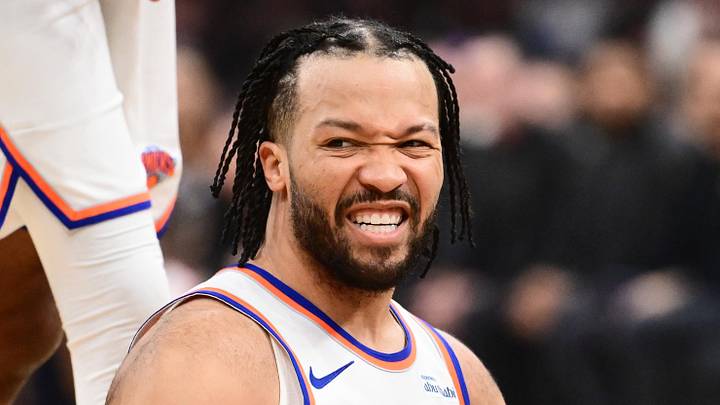
While Milwaukee was busy mortgaging its future on one more Giannis run, New York was playing a different game entirely. And it looks like they won it.
Speaking over Brian Windhorst & The Hoop Collective, Windhorst laid out what the Knicks' front office actually saw coming years ago. And considering the Knicks are now in the NBA Finals, it's certainly an impressive show of foresight for a rapidly evolving Eastern Conference landscape.
"Their play all along, when they evaluated the incoming aprons and what they had, was to win the long game against the Celtics and the Bucks. They believed — especially when Jalen Brunson took that contract that freed them up to put this team together — their play was: because of the aprons and the situation, we will outlast the Celtics and the Bucks," he said.
"And that looks right now like that strategy is coming home."
The Bucks are watching the Knicks’ long-term plan come together
The Knicks didn't just stumble into contention by accident. Obviously, they engineered it with smart moves to build around a franchise player they didn't expect in Jalen Brunson.
But they also did so specifically by watching Milwaukee and Boston paint themselves into a corner and waiting for the walls to close in.
The second apron, introduced in the 2023 collective bargaining agreement, was designed to punish exactly the kind of roster construction the Bucks leaned on for years. To recall, any teams above the second apron are barred from signing buyout players, using the mid-level exception, or aggregating salaries in trades. Milwaukee spent multiple seasons either at or near that threshold, handcuffed by the contracts of players who were supposed to push them over the championship hump and instead just pushed them over the luxury tax line.
And so the flexibility they needed to reload never came, because the bill for the previous era never stopped arriving. Now that the Bucks are set to remain cash-strapped by the Damian Lillard waiver for the foreseeable future, it's looking like New York was right to bet on the apron debilitating the once-contending Milwaukee.
Boston has the same problem, maybe worse. The Celtics are projected to be one of the deepest into apron territory of any team in the league, with limited draft capital and a roster construction that made sense for a championship window that may already be closing. They won the title in 2024. Since then, the financial architecture of that team has become its own trap.
New York, meanwhile, did the opposite. Brunson's hometown discount, a four-year, $156 million deal that was significantly below his market value, ended up being more than just a loyalty gesture. It was the financial foundation of an entire competitive strategy.
Once locked in, that contract bought the Knicks the cap flexibility and roster maneuverability that Milwaukee and Boston methodically spent away. While the Bucks were signing veterans to plug holes and praying the supporting cast held together long enough, New York was quietly stacking assets, developing depth, and staying nimble below the apron threshold.
The results are obvious today. The Knicks are in the Finals just waiting for their matchup from the West. They eliminated Cleveland with a deep, versatile roster that doesn't have a single catastrophic contract dragging it underwater. They have young players who have grown into real contributors. They have draft picks. They have options.
Milwaukee, meanwhile, is heading into an offseason with a 32-50 record, a possibly disgruntled franchise player they don't know if they should trade, and a roster built around a window that closed without warning.
The Bucks have a lot to learn from teams playing the long game
Perhaps the cruelest part of Windhorst's framing is how passive it sounds. The Knicks didn't beat the Bucks by outplaying them. Instead, they outlasted them. They just had to be patient and structurally sound while Milwaukee self-destructed. That's win that took shape within a spreadsheet, years before anyone noticed. And like many other teams that looked to the future in a rocky present, it happened because the Knicks decided to play the long game.
The apron era was always going to punish someone. The Bucks just didn't realize they were the lesson the rest of the league was learning from. New York saw it coming, built accordingly, and is now watching the Eastern Conference Finals from the inside while Milwaukee figures out what comes next. And Milwaukee is likely losing its franchise player to the litany of suitors in the East.
The long game is over. The Knicks won.
 Add us as a preferred source on Google