

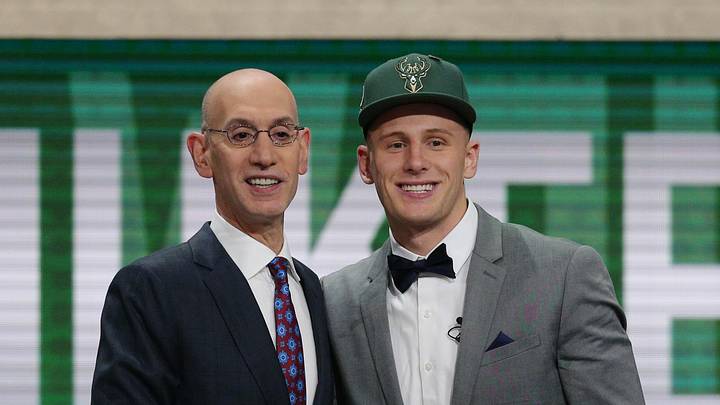
The Milwaukee Bucks are just a day away from one of their most pivotal NBA draft nights in recent memory. Here to break it all down, Behind the Buck Pass invited four draft analysts to offer their thoughts on the Bucks' options ahead of the 2026 NBA Draft in a special guest roundtable discussion.
Whether you've been following our draft coverage for the past few months or are just now trying to get up to speed on the prospects to watch when the Bucks are on the clock Tuesday night, the following discussion should serve as a perfect crash course that provides some diverse and fresh perspectives.
Each of our guest analysts has put in a ton of scouting work this draft cycle. They've watched the film, pored over the analytics, assembled their big boards, and now offer their expert insights into which prospects Milwaukee should target, optimal draft strategies, and more.
Before we get started, though, let's introduce our guest draft analysts:
- Ben Pfeifer (@bjpf_ on X): Ben writes for EssentiallySports and Swish Theory, while providing excellent scouting breakdowns and draft coverage on his rapidly growing YouTube channel.
- Chuck (@ChuckingDarts on X): Host of the superb Chucking Darts NBA Podcast, you can also follow Chuck's Bluesky for all his scouting clips or subscribe to his Substack.
- Nathan Grubel (@DraftDeeper on X): Nathan provides high-quality coverage of the NBA, G-League, and NBA Draft for No Ceilings.
- Ryan Kaminski (@beyondtheRK on X): Ryan is an NBA Analyst for Bucks On SI and hosts the Learning Basketball Podcast with Swish Theory. You can also subscribe to him on YouTube and Substack.
Since we had a lot to discuss below, you can use the below Table of Contents to jump around to each of the five topics we touched on!
Table of Contents
- Potential Giannis trade looms large over the Bucks' draft strategy
- The lottery is loaded with small guard prospects
- Project players who could thrive under Taylor Jenkins
- Bucks may add a future backcourt partner for Ryan Rollins
- Star upside swings the Bucks could realistically target
Potential Giannis trade looms large over the Bucks' draft strategy
Question: Addressing the 7-foot-tall elephant in the room, there’s obviously been a lot of buzz leading up to the draft about potential Giannis trade scenarios in play. If you worked in Milwaukee’s front office, would your draft board change drastically based on whether Giannis is traded or commits to signing his extension in October?
Ben Pfeifer: Even if Giannis Antetokounmpo remains in Milwaukee for the long-term, I’d still prioritize star-level talent in any shape or size with this roster. Aside from Ryan Rollins, that roster badly needs a needle-moving young player to build around. That might move the target away from an older player like Yaxel Lendeborg, who likely wouldn’t vault the Bucks to title contention in year one or two.
Chuck: I would not let the Giannis negotiations affect my board. The only reason to let those negotiations affect prospect rankings is if the front office believes that there is some prospect out there who can play next to Giannis right now and meaningfully help the team contend immediately within Giannis' window.
At pick 10, the only prospects who arguably fit that description are Yaxel Lendeborg and Aday Mara. Everyone else will take more time. But even if Yaxel or Mara can play immediately, it is bad practice to bring in a rookie with the expectation that they solve a contender's roster problem.
The NBA is too difficult and the adjustment in competition too severe to ask that of any rookie. The Bucks should target players that they believe they can help succeed on their team. Yaxel and Mara still might be the right choices, but that should be Milwaukee's approach.
Nathan Grubel: If I were in the Milwaukee Bucks front office, my draft board would have to change at least slightly depending on the outcome of whether Giannis Antetokounmpo stays or is traded.
Largely because, if Giannis is on the move, there's a high degree of certainty that I would have access to an additional first-round pick in this draft, potentially another lottery selection. That in itself is a game changer, not only because of having additional draft capital, but the types of players I would have access to with a much more reasonable degree of draftability.
For example, some players are viewed as "riskier" swings in this draft between Nate Ament, Aday Mara, and Jayden Quaintance for different reasons, but all could return legitimate top 10 value in this draft down the line. If I were to pair one of those players with another who is viewed as having a more "assured" floor, then that is a much easier sell to an ownership group and the fanbase.
Taking a player who has an immediate pathway to contribute in some form on both ends of the floor, paired with one of those aforementioned names, could be an incredible jump start to a post-Giannis rebuild.
Ryan Kaminski: While the tiers of prospects on my Big Board would stay the same with or without Giannis on the roster, the actual selection and order of prospects within those tiers could definitely change.
Thankfully for Milwaukee, many of the prospects in their 10th pick range achieve both goals of upside and fit with Giannis, so there’s not too many choices where they have to fully commit to just one.
The Bucks should target the best prospect available either way, but if there’s any chance or glimmer of hope that their face of the franchise will stay put with the right fit, and if all parties want to commit to that plan, then you have to consider those options.
If Giannis was out of the picture, Milwaukee would probably need to take more risk for potential stars; with Giannis in the picture, it’s more palatable to bridge tomorrow and today, and with options like a Brayden Burries, Labaron Philon, Dailyn Swain, Ebuka Okorie, Christian Anderson, or even potentially Mikel Brown Jr being there in that range, this draft in particular should provide plenty of options to achieve all these goals at once.
The lottery is loaded with small guard prospects
Question: With the abundance of smaller guard prospects projected to go in the lottery range, there’s been a lot of discourse this draft cycle around the team building challenges that come with drafting that archetype of player. Where does your own draft philosophy fall on that spectrum of debate, and is there a particular prospect or two from this class you’re flag planting to thread that needle at the pro level?
Ben Pfeifer: I’ve long touted the value that smaller guards bring despite their obvious teambuilding issues. There isn’t one valid teambuilding method; the Knicks constructed a title-winner around Jalen Brunson (and Jose Alvarado!), and if teams believe in the ceiling and impact a smaller guard prospect could provide, that size shouldn’t dissuade them.
The 2026 draft features an uncanny amount of blue-chip guard prospects shorter than 6-foot-4 and beyond the consensus top 5-10 picks, Labaron Philon and Ebuka Okorie are as good as or better than players routinely mocked in the top 10.
Both bring elite live-dribble creation and generate consistent offense in the half-court in their own unique ways, a critical translation marker for shorter guards, alongside numerous other strengths.
Chuck: Small guards are extremely challenging to build around, and my philosophy tends to favor passing on them. The marketplace for guards is already oversaturated. Not only have stars like Ja Morant or Trae Young been available for expiring contracts, but down the spectrum, helpful guards like Collin Gillespie, Ty Jerome, Coby White, and Ayo Dosunmu have been available for very, very little investment from the acquiring team.
The draft is as much an exercise in deselection as it is in selection; each team passes on far more players than it chooses, and each draft pick should reflect the player an organization is most worried about playing against, as opposed to the one they are most "in love" with.
In this year's class, the undersized guard (6'4 or shorter) I believe is worthy of a top 10 selection is Houston's Kingston Flemings. If he were 6'5 or 6'6 in socks, he would likely be my number 1 pick. He has exceptional court vision and feel for the game, exceptional athletic tools, exceptional shooting touch, and exceptional motor and intangibles.
One other guard, Stanford's Ebuka Okorie, is ranked in my top 10, but he will be available later in the draft for a shrewd team to trade up and acquire. He has the draft's best handle (only Dylan Harper matches his live dribble talent in the last several drafts) and can get to any area of the floor quicker and more creatively than anyone else.
Nathan Grubel: I've definitely leaned away from drafting guards near the top of previous drafts, in large part because the bar has never been higher to play that position in the NBA over the last twenty or so years than it is today.
The NBA is deep with potential starting or rotational guards, as more players coming into the league are inclined to measure anywhere from 6-foot-1 to 6-foot-3, so there is just more access to trade for and acquire those players.
And the ones who have actually found great success as stars in the league are playing at such an absurd level offensively that it has made it tough to view prospects as having those types of ceilings. What makes this class unique is that these guards are so complete and well-rounded offensively to where I've found myself ranking a glut of them in the lottery on my board.
Yes - size, strength, and length matter in the league. But so does dribble/pass/shoot skill with real feel and ability to make others around you better. These guards near the top of this draft have such tangible skill sets to impact the game right out of the gate to where I feel comfortable about what their development can look like, even if they're viewed as "targets" defensively.
Ryan Kaminski: Small guards can help championship teams win, even if they have to be special talents to do it. While the floor of being an NBA player is generally lower for players below 6-foot-2 or so, there are still plenty that succeed.
While some guards are small in height relatively, they make up for it in wingspan, which is effective length for defense at the NBA level. The main concern with small guards is that they have to be neutral defenders to make winning impact and stay on the floor at the playoff level; as for the regular season, they can get away with being offensive focused.
Lastly, there are outlier players and offensive star guards that initiate, run the show, and make life easier for everyone; some are the sun the whole offense revolves around. Good front offices should be able to build two-way balanced lineups that cover up deficiencies and maximize strengths of all players to give them the best chance to succeed.
In this 2026 class, my flag plant guard prospects are Ebuka Okorie and Labaron Philon. I have Darryn Peterson, Ebuka Okorie, Kingston Flemings, Labaron Philon, Keaton Wagler, and Dailyn Swain in my top 10, so I think all of those names are great bets to make for NBA players, and shows the incredible depth of talent in this guard/wing class, with plenty of other names who other scouts are higher on for their own reasons.
Okorie is a unique talent to me with his blend of elite traits – quick first-step burst, masterful handle, incredible two-way feel, defensive indicators in effective length and forcing turnovers without fouling, turnover suppression, rim shot volume, and 3-point volume indicators.
Okorie will be the steal of the draft for any team that bets on him as a pick-and-roll maestro who can run the offense as a point guard and double as a team’s first option on any possession. He projects to be one of the best shooters of the draft, as well as a walking paint touch because no individual defender can stop his speed and handle combos.
Philon is a special talent, a herky jerky driver who creates his own shots in funky ways that is effective against defenses because he specializes in the shots that defenses want him to take.
Philon is an efficient shooter on and off the ball, a natural scoring creator for himself and his team, and a team-first decision maker with the feel to make winning hustle plays on one end and create efficient shots on the other.
Philon is an all-around smart player with better defensive instincts who plays stronger hunting bump-and-finish contact than people give him credit for due to his recorded weight. He could be incredibly difficult to stop from scoring without fouling at the NBA level and is a walking winning play.
Project players who could thrive under Taylor Jenkins
Question: The Bucks’ brass brought in new head coach Taylor Jenkins in large part due to his strong track record of player development. Is there a prospect on your board who you feel is particularly dependent on the proper development context to hit their higher range of outcomes?
Ben Pfeifer: If Milwaukee under Taylor Jenkins becomes a player-development hotbed, no player stands to gain more from an optimal context and environment than Jayden Quaintance.
The Kentucky big man lost nearly his entire sophomore season rehabbing an ACL injury from winter 2025. It’s easy to understand the risks associated with a medical and film perspective, but his gigantic ceiling could pay a brave team huge dividends.
As a 17-year-old freshman at Arizona State, Quaintance thrived in a power conference and flashed future All-Defensive upside as the youngest player in the sport. He boasts true center measurables with wing movement skills and flashes those tools on the offensive end as well.
There’s an undeniable risk involved with Quaintance, especially considering his extremely poor shooting projection, but prospects with his ceiling rarely fall outside of the top 10.
Chuck: For players consistently mocked in Milwaukee's range, I'd say Mikel Brown Jr. needs a lot of developmental attention. He has plenty of talent in his handle, his shot, and his passing acumen, but he applies those three skills somewhat inconsistently.
He can make some panicked decisions on when and where to shoot (long stepback threes early in the shot clock) and when to pass. He picks up his dribble quickly when he feels pressure and that frequently leads to ill-advised passes or live dribble turnovers.
For him to mature into a winning guard, he needs a great context that smooths out his process and makes sure he understands the value of slowing himself down and understanding all of his options on the floor.
Nathan Grubel: Nate Ament is the most popular name for the Milwaukee Bucks right now, and I do think he needs a certain developmental track to hit his highest outcome on the court.
If I’m a team looking to draft Nate Ament, I’d first focus on making sure he gets comfortable shooting spot-up and catch-and-shoot threes on good volume. Then it’s about working on his handle, developing counters and expanding that mid-range game, and learning how to recognize different defensive coverages off those counters to look for passing windows. Hopefully, you'd focus on coaching up Ament on the team's defensive principles and how he needs to approach defending away from the ball.
He’s a 6-foot-10 forward who manufactured free throws at an excellent rate and wasn’t afraid to find contact downhill. That’s a great scoring skill, but finding ways to get him real shots within the flow of the offense is priority before the ball is in his hands more often to self-create those drives.
Ryan Kaminski: Chris Cenac Jr. comes to mind as a talented prospect who may be a bit raw now but shows a handful of great indicators to build around.
As an elite rebounder with great effective length as a stretch four who can play some five, Cenac brings an old school midrange pick-and-pop game and post-up counter moves to attack closeouts off his shooting gravity.
He’s not a full-blown 3-point threat yet but certainly shows the touch and shooting indicators to stretch out his middy to the 3-point line eventually.
A grab-and-go playmaking forward with heads up vision on kickout passes, Cenac can develop into a playfinishing floor-stretching connective 4/5 who rebounds well, brings help-side shot blocking with mobility and length on defense, and makes team first decisions on offense.
Improvement as a finisher at the rim, as a 3-point shooter overall, and refining the counter moves as a scorer could allow Cenac to develop into one of the better talents in the draft who projects to slip. With Jenkins's record of helping Jaren Jackson Jr. develop in Memphis, Cenac is a prospect that Jenkins could potentially help develop and maximize his game.
Bucks may add a future backcourt partner for Ryan Rollins
Question: A recent Jake Fischer report indicated that the Bucks have interest in acquiring another pick inside the Top 10 and linked them to four guards: Mikel Brown Jr., Darius Acuff, Keaton Wagler, and Kingston Flemings. While you’d likely prioritize talent over fit in any scenario in which Giannis is traded, is there a prospect from that group you could envision thriving alongside potential backcourt mate Ryan Rollins?
Ben Pfeifer: Rollins’s paint pressure generation opens the door for Milwaukee to add a less bursty backcourt mate, and Keaton Wagler, if the Bucks traded high enough to acquire him, would make for an excellent counterpart. Wagler’s subpar explosiveness often dominates his discourse, and his limitations as an advantage creator could cap his pure on-ball ceiling.
He’d thrive as a complementary scorer and creator paired with Rollins, who breaks defenses with burst and speed. Wagler is a stellar shotmaker and a truly rare decision maker for a teenager with his usage. His athletic deficiencies and poor wingspan cast some doubt on his defensive projection, but Rollins’s strong playmaking and potential strength development for Wagler could form a solid tandem in time.
Chuck: There are several good options should the Bucks trade up, but I would prioritize Kingston Flemings or Keaton Wagler out of that group.
Flemings is a very malleable two-way talent whose tools I believe were suppressed a bit at Houston, so for all of the reasons above, he would be a great teammate to run with another two-way talent in Rollins.
Wagler is a bit bigger at 6-foot-6 and can provide consistent spacing off of Rollins right away. Wagler is renowned for his poise and pace with the ball in his hands, and his consistent ability to get to the paint either in the pick-and-roll or attacking closeouts should keep Milwaukee's offense moving and give Rollins plenty of options to work with as well. Those two marry on and off-ball versatility a bit more than Acuff and Brown.
Nathan Grubel: If discussing a fit alongside Ryan Rollins, naturally, you're hoping to find a guard who can slot in positionally next to him without compromising size and defense in the backcourt. So, there's an obvious inclination to suggesting Keaton Wagler or Mikel Brown Jr. make for "cleaner" fits.
However, as much as Rollins has improved over the course of the last few seasons and is the sole young bright spot for the Bucks on this roster, he's not at the level of player YET that I'm letting him stop me from grabbing the best player available.
If this front office can draft Darius Acuff or Kingston Flemings with a higher pick potentially acquired in a Giannis trade, then that should absolutely be the decision.
By my board, I feel Wagler and Brown have the highest ceilings at the position in this draft, but Acuff could work on and off the ball alongside Rollins, and Flemings played with several guards last season at Houston. Any of these guards would provide long-term solutions for this Milwaukee team with or without Rollins in the mix.
Ryan Kaminski: Agreed that if Giannis is gone, I’m considering the best player available first before any fit with Rollins if there’s a potential franchise cornerstone to build around. To me, there could be many of those in the top 10, which would take priority over Rollins.
That said, Rollins is a great 3-point shooter and good scorer and connective playmaker type that would fit with just about any guard Milwaukee could wind up taking. If the idea is Rollins as the secondary option, than to me the best player available would be Ebuka Okorie or Kingston Flemings.
Since I’m higher on Okorie than most and already planted that flag, let’s focus on Flemings. Kingston could be a franchise point guard, full stop.
He has incredible two-way feel for the game, runs pick-and-roll with ease, shows great body control deceleration getting to the paint, and while he can refine the pull-up 3-point efficiency, he’s already a confident shooter threatening defenses anytime they duck screens.
He’s tough, he cares about winning, and he will run an NBA offense for the foreseeable future; that might as well be in Milwaukee if they want to see good decisions consistently made on the basketball court.
After Flemings, I’m highest on Keaton Wagler, then Mikel Brown Jr., then Darius Acuff as my best players available, and I’d stick with that order when weighing in Rollins, since they’re all mostly on-ball bets on star guard creators as well.
Star upside swings the Bucks could realistically target
Question: If a Giannis trade does occur prior to draft night, Milwaukee may find themselves with more than one pick in the first round while staring down the barrel of a rebuild. Outside of the consensus top 4, who are your most confident star-upside bets in this class and why?
Ben Pfeifer: As previously mentioned, Okorie feels like this class’s version of Tyrese Maxey, destined to fall farther than his profile suggests. His blistering speed, scoring creation, and athletic tools reflect a top 10 pick in a strong draft.
Dailyn Swain’s elite ball handling and drive creation on the wing make him another sneaky star bet. If he continues progressing as an off-dribble shooter, it’s easy to imagine him thriving as a scorer.
Chuck: Outside of the top 4, Flemings and Wagler are certainly good swings to take. But since I have discussed them as well as Okorie, I will highlight Allen Graves from Santa Clara and Yaxel Lendeborg in a bit more detail.
Both Graves and Yaxel are 6-foot-8-plus wings with talent on both sides of the ball. Yaxel has the higher profile as a driver of Michigan's dominant run to a national title, and I believe the concerns about his age (24 in September) are a bit overstated because he should not be out of place physically in the NBA.
Older prospects usually have lower ceilings because they are unexceptional physical talents. But with a 7-foot-3 wingspan with an advanced ability to read the floor, Yaxel can flourish in NBA space as, essentially, a massive guard who can rebound, operate possessions, and score at all three levels while providing solid connective defense. Any player with a base that high can mature into a star in their late 20s.
Graves, meanwhile, is the draft's biggest curiosity. As a 19-year-old this past season, he played small-ball center off the bench for Santa Clara and constantly produced outcomes NBA teams covet: offensive (and defensive) rebounds, defensive deflections and disruption, and efficient catch-and-shoot threes.
Graves is not an elite athlete, but his motor runs red hot, and he is relentlessly physical in applying his outstanding hands to win battles on both sides of the ball. That may sound like a role player, and most evaluators who like him favor him as a good role player bet.
I am more optimistic because I think that Graves has a rare ability to process a possession before it unfolds. He just does not have the reps handling the ball yet to leverage that IQ into manipulating opposing defenses.
But he already protects the ball well and has comfort driving physically. His role player qualities will get him on the floor. If he can cut his fouls (which I believe he will playing on the wing more frequently than the post in college) and rep out driving with players on his hip, I believe Graves can consistently get to the paint, dislodge his defenders, and draw defensive help.
That's where he can grow as a passer and finisher and, hopefully, turn into a unique, two-way force that constantly helps drive winning basketball.
Nathan Grubel: Since we discussed the guards at length above, I'll offer up other answers on my board. After that group of guards and the consensus top 4, I have Yaxel Lendeborg, Morez Johnson, Christian Anderson, Hannes Steinbach, Labaron Philon, and Cameron Carr rounding out my overall top 15.
With a second lottery pick (or even mid-first pick), I'd value any of those options along with Aday Mara and Nate Ament, both of whom I have just slightly outside of that range. The Bucks are in an interesting position, not controlling their own draft for several seasons into the future, so this team stands to remain competitive in the short term while building in the future post-Giannis.
Lendeborg could still be in consideration for that very reason, as he possesses a real lethal combination of skill and feel at a position type that tends to manufacture star-level outcomes if everything hits.
Johnson is a different type of "star" but an important piece to winning high-leverage games as a do-it-all defensive big who can guard virtually any position on the floor while rebounding, blocking shots, and playing with ferocity and a motor that never stops. He doesn't offer the same offensive upside as the perimeter-based creators, but could be an All-Defense mainstay in the league for years to come.
Anderson and Philon have very similar star guard arguments as I laid out for the players above them. And guys like Carr and Steinbach offer skill sets that get them on the court immediately (shooting and rebounding, respectively), which can lend to extended minutes and reps to round out and develop their other skill sets. They play the part athletically and have real pathways to become more than who they're perceived to be, if everything breaks right for them.
Ryan Kaminski: Ebuka Okorie, Kingston Flemings, Labaron Philon for the reasons stated above are my star upside bets I’m most confident will be good pros with tangible star upside at the next level.
The next two less discussed I’d suggest would be Keaton Wagler and Dailyn Swain. Wagler’s body control deceleration is the sneaky athleticism most don’t credit him for, as he’s able to get any spot and run entire offenses even with his physical disadvantages.
Between Keaton's pull-up 3-point threat, his bump-and-finish foul drawing, his efficient shot creation for his team, his ability to run pick-and-roll and push the pace, and his high impact ratings, there are many signs that Wagler’s rise through the draft ranks this season are for good reason. One can envision Wagler running an NBA offense.
Swain projects to be a plus defender, but his rare skill is his ability to handle the ball so well at his height. Swain getting anywhere he wants on the floor with his graceful downhill athleticism and sound dribble moves makes him a plus defender and two-way rim force with enough wiggle and off-the-dribble chops to provide hope for a good scorer and sound shooter who can hit the open three.
I’d bet on Okorie, Flemings, Philon, Wagler, Swain in that order for their potential star upside and high overall impact being good basketball players in the NBA. I don’t know if Yaxel has offensive star potential, but I am higher on him for his two-way impact and versatility, especially as an All-Defensive two-way type star as well in the top 10 range.
 Add us as a preferred source on Google