

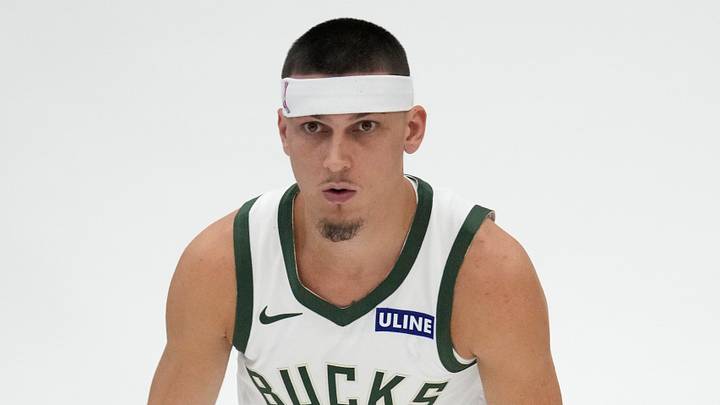
As training camp begins for the 2026-27 NBA season, the Milwaukee Bucks find themselves facing a level of rotational uncertainty they haven't experienced in more than a decade. With fresh dynamics under Taylor Jenkins and a transformed roster featuring an influx of versatile talent, Milwaukee enters the preseason without a set starting five lineup or defined core rotation. This is as much by design as by circumstance, as the coaching staff is using training camp as an open laboratory.
A roster rebuilt from scratch
The Bucks traded Antetokounmpo and Bobby Portis Jr. to the Miami Heat for Tyler Herro, Jaime Jaquez Jr., Kel'el Ware, Kasparas Jakucionis, and a haul of draft picks. They also used the No. 10 and 13 picks to draft Brayden Burries from Arizona and Nate Ament from Tennessee. This will all be navigated under Jenkins. The result is a roster with overlapping skill sets and few obvious pecking orders.
The competition at guard is perhaps the most glaring open race on the roster. The arrival of explosive scoring threat Tyler Herro gives the Bucks a primary playmaking option, but where he fits and who he shares minutes with remains to be seen. Jenkins will have to determine who the offense will run through, as Herro is not a traditional point guard, per se.
Point guard duties should be shared between Ryan Rollins and Kevin Porter Jr., although the two bring vastly different styles and philosophies to the position. Rollins offers dynamic speed and distribution, while Porter provides physical scoring.
The Bucks boast elite perimeter depth with sharpshooters like re-signed Gary Trent Jr. and AJ Green, alongside veteran Caris LeVert. Selecting who opens games versus who anchors the bench unit will depend heavily on preseason chemistry.
The wings and frontcourt present another strategic puzzle. With veteran power forward Kyle Kuzma in the fold again, the coaching staff has a proven scorer who can space the floor and rebound. However, young forwards like Jaime Jaquez Jr. and Ousmane Dieng provide compelling reasons to disrupt traditional roles. Jaquez's playmaking toughness and Dieng's defensive length offer flexibility, which allows Jenkins to experiment with both traditional big-ball lineups and switchable small-ball ones too.
At center, Myles Turner provides high-level rim protection and stretch five ability. Behind him, athletic young bigs Kel'el Ware and Jericho Sims offer distinct bench looks, which make the center rotation another active and open evaluation.
Preseason should sort it all out
On another note, how fast will Jenkins move to the rookies? Burries, Ament, and Jakucionis should get extended developmental minutes, but none of them really need to be rushed into a starting role. The bench is also somewhat of a puzzle. It can be argued that the bench is deeper than the starting five is strong. Realistically, Jenkins can't develop everybody at once, so he will have to somehow manage this.
Rather than viewing the lack of a set starting five as a weakness, the Bucks' organization is embracing the ambiguity as a strength. With a grueling 82-game regular season schedule ahead, having multi-positional lineups that can morph based on matchups will be a priority.
As preseason action begins, the starting five that takes the floor on opening night may look entirely different from the group closing games by midseason. For Milwaukee, the 2026-27 campaign starts not with set roles, but with open competition across every spot on the floor. Fans should expect experimentation, as more than likely, the Bucks won't contend right away. The team's priority should be to remain competitive while testing which of the young players will be part of the future.
 Add us as a preferred source on Google