

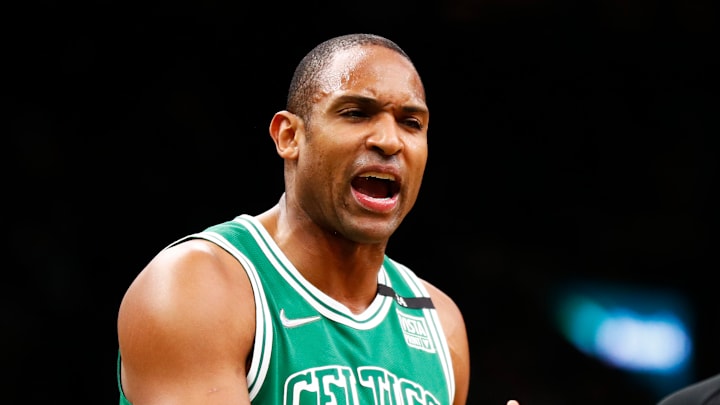
There was a moment last summer when the Milwaukee Bucks front office was genuinely mulling over whether it should go get Al Horford. It was a valid temptation at the time; he was a big name with a big resume who could potentially offer a big narrative swing after losing Brook Lopez to the Los Angeles Clippers.
Horford, after all, was a five-time All-Star, a champion, and a proven vet. On paper, it looked like the kind of stability Milwaukee desperately needed. Yet, the front office still stuck to what it now knew to be true and decided it needed legs over legacy. That call looks smarter by the day.
Al Horford is struggling, while Jericho Sims has found a role
Horford, now 39 and running on fumes in Golden State, is putting up 5.6 points, 4.4 rebounds, and 2.0 assists while shooting a rough 32.1 percent from the field and 29.8 percent from deep. Because of injury problems, he’s barely cracking the rotation. He looks every bit like a player at the finish line, not one who could’ve held up over 82 games next to Giannis Antetokounmpo and this aging core.
Meanwhile, Milwaukee “settled” for Jericho Sims.
Sims wasn’t just a backup plan. He was an injection of youth, energy, and verticality this roster badly needed. The Bucks were historically one of the oldest teams in the league, stuck in that cycle where the names got bigger but the legs got slower. Sims broke that trend.
On defense, Sims provides rim protection without needing rest every other game and can move defensively without getting exposed. According to Cleaning the Glass, opponents scored -2.2 fewer points per 100 possessions whenever Sims was on the court, a number that was good for the 71st percentile among bigs.
The eye test proves that to be true: you plug him in, and he gives you live-ball athleticism Horford physically can’t offer anymore. For a time, the Milwaukee Bucks' best defensive weapon was pairing Giannis and Sims together in the same lineups.
On the other side of the ball, Sims' bread and butter is running the floor hard in transition and making himself available for lobs. Those are foundational qualities that championship teams need from their backup bigs, and Horford simply can't deliver them anymore at this stage of his career.
Think about what happens when the playoffs come. Sims becomes the better option immediately. He defends, keeps the Bucks afloat at the five (at least against other backup bigs), and he doesn't need a decade of experience to do it—just fresh legs and effort.
That's worth infinitely more than Horford's name recognition at this stage of their respective careers. The front office understood that even when fans were clamoring for the bigger name.
Milwaukee's roster construction problems are real, but signing Horford would've made everything worse and wouldn't have solved any of the same problems they had with Brook Lopez. They'd be even older, even slower, even less athletic. Exactly the opposite of what they actually need to compete in today's NBA.
The story here is that the Bucks were linked to Horford. They seriously considered it. But they zagged away when everyone expected them to lean on the shiny resume. The decision wasn’t about disrespecting Horford; it was about being honest about where this team is.
 Add us as a preferred source on Google