

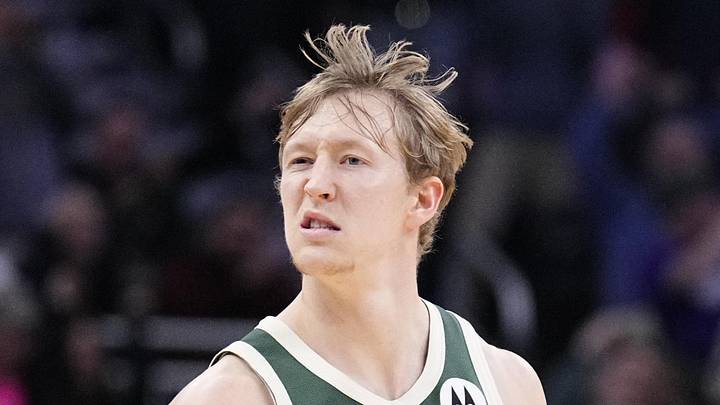
Taylor Jenkins's proven track record of player development from his coaching days in Memphis was a key factor in the Milwaukee Bucks' decision to hire him as their next head coach, and sharpshooter AJ Green is one player who could benefit significantly from a change in approach.
Despite Green coming off an up-and-down 2025-26 campaign, Taylor Jenkins already holds the blueprint for unlocking the 26-year-old's game after coaching up a former Grizzly of a similar archetype: Luke Kennard.
AJ Green may not be one of the first names that come to mind when envisioning potential player development candidates under Milwaukee's new coaching staff.
Green could be due for a big year
Entering his age-27 season, it's fair to wonder whether the former two-way guard has any further upside to tap into. After all, Green's already hit a relatively high-end outcome as far as most former-undrafted players are concerned.
Given the murky future of franchise legend Giannis Antetokounmpo heading into this pivotal offseason, it's also fair to wonder whether AJ will even still be in the Bucks' long-term plans if the organization ultimately heads toward a full-scale rebuild.
After all, one of AJ Green's greatest strengths is his strong chemistry with Antetokounmpo on the court. In Green's four seasons played in Milwaukee, Giannis has seen a +4.5 swing in net rating when he shares the court with AJ Green. That's a large sample of positive impact.
There are also some frustrating aspects of Green's game that made him somewhat of a polarizing player this past season. For one, he almost exclusively looks to score from behind the arc, which is limiting for a player who saw a career-high in minutes last season.
Though Green has consistently shot north of 40 percent deep every year of his career, he also has a tendency to pass up open looks despite being Milwaukee's most dangerous off-ball shooter on the court in most instances, which is saying a lot considering the Bucks ranked third amongst teams league-wide in effective field goal percentage this past season.
On top of that, Green also struggled to remain viable defensively much of last season. Part of this came from him being overtasked on an undersized roster in being asked to defend larger wing players on a nightly basis.
Assuming Green continues donning the green and cream heading into next season, however, there's plenty of room for optimism around what Taylor Jenkins's new system, philosophy, and development program could do to accentuate his strengths and mask his flaws.
After all, it wasn't long ago that a Jenkins-led team acquired a player with similar limitations in Luke Kennard and put him in a position to succeed alongside the young core in Memphis.
Luke Kennard's Memphis deployment is the blueprint
When Luke Kennard arrived in Memphis shortly after the 2023 trade deadline, he was in the midst of an efficient, albeit disappointing, age-26 season coming over from the Los Angeles Clippers and in need of a change of scenery.
After a strong 2021-22 campaign in which he finished fifth in Sixth Man of the Year voting, Kennard had become increasingly passive on offense to the detriment of his team on a crowded Clippers roster that featured a lot of scorers.
After shooting nearly 45 percent on six 3-point attempts per game the previous year, Kennard's efficiency remained consistent, but his attempts from long range plummeted to 3.8 per game. His hesitancy to shoot tanked his offensive impact as well as the Clippers' spacing while he was on the court, with his offensive box plus/minus (OBPM) dropping from +0.8 to -1.4 year-over-year.
Taylor Jenkins immediately began challenging Kennard to shoot more as soon as he joined the club. Whenever he passed up a shot, Jenkins and his teammates let him know about it. That culture shift ended up being just what the then-26-year-old needed to get out of his funk.
It wouldn't be long before Luke Kennard set a new franchise record with ten 3-pointers made during a game in March against the Houston Rockets. Post-deadline, Kennard shot 5.7 threes per game on blistering 54 percent efficiency, and his -1.4 OBPM with the Clippers skyrocketed to +3.0 in Memphis.
Jenkins's offensive philosophy in Memphis strongly emphasized scoring in the paint and getting downhill with Ja Morant as the engine, so the addition of Kennard offered the Grizzlies offense another effective release valve on the perimeter to pair with Desmond Bane when opposing defenses collapsed.
Jenkins also employed some creative defensive coverages to hide Luke Kennard's shortcomings on the defensive end. For instance, in Kennard's first full season with the team, the Grizzlies' defense became very switch-heavy after Steven Adams went down with injury early in the year.
However, when teams tried matchup hunting Kennard on switches in the pick and roll, Jenkins would have Kennard aggressively "hedge" the ball handler on the switch before quickly recovering back to his man.
When executed correctly, this tactic can disrupt the dribble path of the ball handler at the level of the screen and cut off the lane to the basket. The ball handler's original defender sags back a bit to pick them back up once the hedger recovers to their assignment. If the screener rolls to the rim, a help defender will tag the roller, and the hedger recovers back to the man left open.
Luke Kennard was the only Grizzly that Jenkins consistently hedged in pick-and-roll coverages that season, and it helped him to remain viable enough defensively to keep in the game for his offensive impact.
Kennard's tenure in Memphis playing under Taylor Jenkins marked a significant, positive shift in his career trajectory and net on-court impact.
Looking at Regularized Adjusted Plus-Minus (RAPM), which uses on/off and lineup-based data over large samples of data to measure impact, Kennard's three seasons in Memphis represented the first in his career where he finished with a positive RAPM (+1.7, +0.2, and +0.4, respectively).
AJ Green already has a leg up on Kennard
If any of that sounded familiar, it should. AJ Green has struggled with many of the same issues as Luke Kennard at similar stages of their careers, but Green also has a considerable leg up on his sharpshooting counterpart compared to when Kennard first crossed paths with Jenkins.
For one, AJ Green already has a couple positive RAPM seasons under his belt. In his third year, he finished with a +2.2 RAPM impact. Despite an up-and-down season this past year, he still finished with a net positive +0.9.
Green also has a bit more length than given credit for at a similar height to Kennard. His 6-foot-7 wingspan compared to Kennard's 6-foot-4 and a half already gives him a bit more to work with defensively, even if he still requires some strategic deployment.
As iconic as AJ Green matching up against Victor Wembanyama has become in recent Spurs games, Jenkins will look to mitigate those defensive possessions moving forward.
Despite a streaky shooting campaign in 2025-26, Green still showed growth one important area. Without Giannis Antetokounmpo for long stretches of the season, AJ was forced into more of an on-ball role which paid dividends for his off-the-dribble shooting development.
In his first three seasons combined, AJ Green shot 35 percent on 141 attempted pull-up threes. This past season alone, he drilled 42 percent of his 139 pull-up three attempts. This is a massive development for a player who relied so heavily on off-ball opportunities alongside Giannis in previous seasons.
Despite his off-the-dribble growth last year, Green's shot attempts frequency has also regressed the past couple seasons. After attempting 17 and 15 shots per 100 possessions as a rookie and sophomore respectively, those rates have dipped to 12 and 13 attempts the past two years.
If Taylor Jenkins can instill a more aggressive mindset in Green like he did with Kennard, there may be another level of 3-point scoring that he can tap into.
After all, it was still just last month that Dairy Bird reminded the Fiserv Forum crowd how dominant he can be when he's aggressive, raining 11 3-pointers down on the Brooklyn Nets to break Damian Lillard and Malik Beasley's previous single-game franchise record. Green would also break the franchise's single-season threes record the following night against the Sixers.
New Bucks assistant could help diversify Green's shot diet
While nearly 90 percent of AJ Green's shot diet consisted of 3-pointers last season, there could also be some room for him to develop his mid-range game and rim efficiency under Jenkins and his new staff.
Recently, Jenkins added his former Grizzlies' assistant Joe Boylan to his new coaching staff. Boylan has been in the league for years and is well-known for his expertise in player development, notably working with players like Brandon Ingram, Jaden McDaniels, and Naz Reid.
Boylan employs a constraints-led approach (CLA) to player development, designing workouts borne of collaborative film study sessions that incentivize the player to work on targeted growth areas in live game situations.
For instance, Boylan worked with Brandon Ingram on developing his off-ball game by designing a practice game where he had to score all of his team's points without dribbling. Ingram was forced to cut, find space off the ball, and move constantly to create scoring opportunities.
One can envision a similar workout designed for AJ Green where he must score all of his team's points from inside the arc. Simulating real game reps in practice is the closest thing to actually applying them in real game situations.
Only time will tell what the future holds for Green in this new era under Taylor Jenkins, but it's pretty safe to assume it will be a better environment for his development than the last couple of years under Doc Rivers.
As he now enters the prime years of his career, AJ Green's best basketball could still be just around the corner.
 Add us as a preferred source on Google